
In this article (13 sections)
- What is custom software development?
- How much does custom software cost in Nigeria?
- What determines the cost of custom software?
- What makes software costs different in Nigeria?
- Freelancer, local agency, offshore team or in-house: which should you choose?
- Build cost vs total cost of ownership
- How long does custom software take to build?
- Should you build everything at once?
- Buy, integrate, customise or build?
- How to reduce cost, and what to ask before you hire
- How Netgrawl approaches custom software development
- Start a project with Netgrawl
- Frequently asked questions
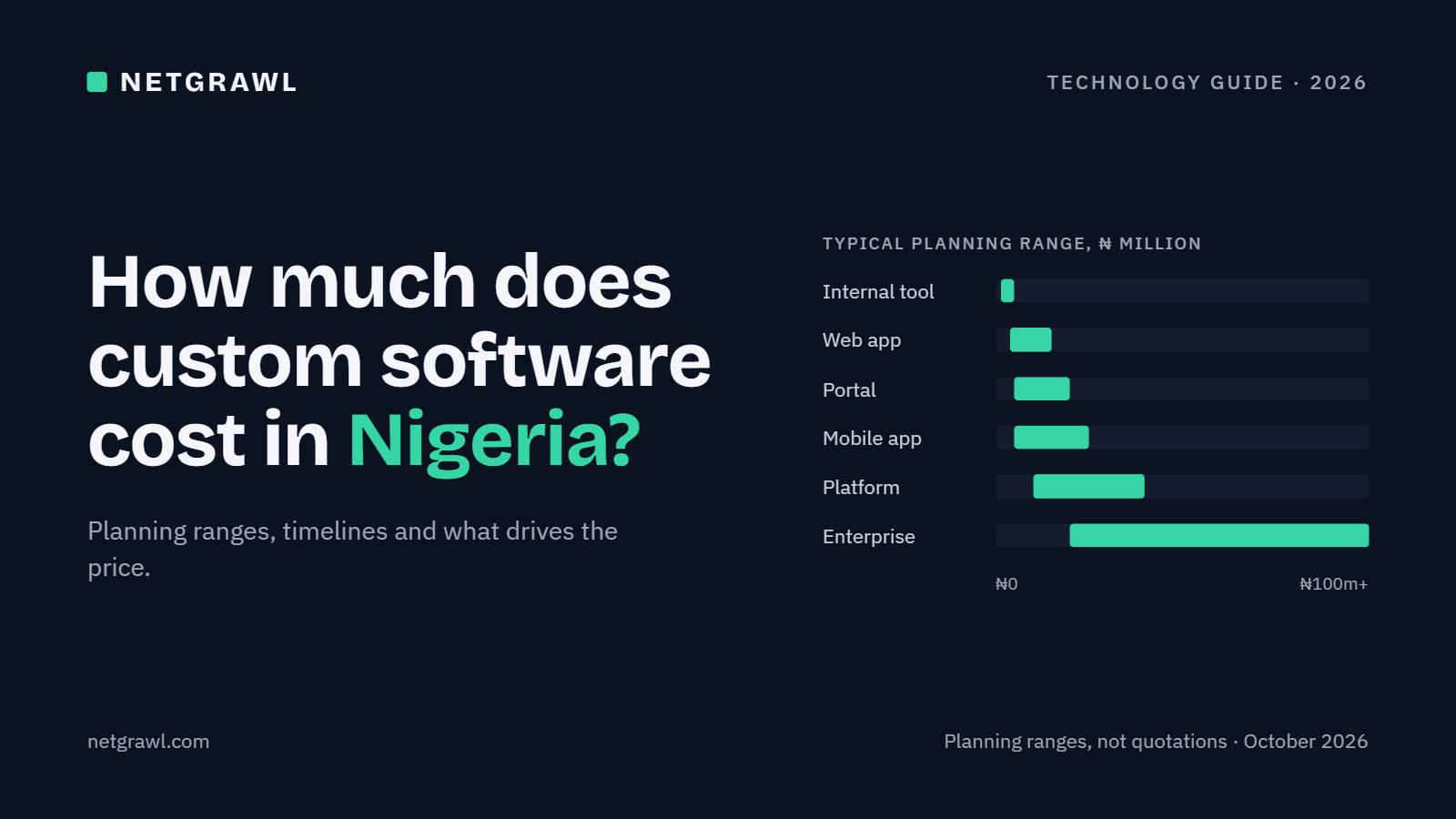
Custom software in Nigeria typically costs between ₦1.5 million for a small internal tool and ₦100 million or more for a complex transaction platform. Most business web applications fall between ₦4 million and ₦15 million, and most multi-sided digital platforms between ₦10 million and ₦40 million. These are planning ranges, not quotations. Budget a further share of the build cost each year for hosting, support and updates. This guide explains what moves a project up or down in Nigeria, who you can hire, and how to avoid overbuilding.
What is custom software development?
Custom software is built around your processes, users, data and integrations instead of bought as a standard product. It covers internal business systems, customer portals, web and mobile apps, marketplaces, SaaS products, workflow automation, financial platforms and system integrations.
Custom does not mean built from scratch. A well-run project combines custom code with cloud services, third-party APIs and open-source components, and builds only the parts that are specific to your business.
How much does custom software cost in Nigeria?
There is no single price, but these planning ranges (updated October 2026) show where most projects sit. Each range assumes discovery, design, development, testing and deployment. Hosting, third-party fees (SMS, payment, verification APIs) and VAT are usually quoted separately, so confirm what a quotation includes.
| Project type | Typical planning range | What usually pushes it higher |
|---|---|---|
| Small internal application or workflow tool | ₦1.5m – ₦5m | More roles, approvals, reports |
| Business web application | ₦4m – ₦15m | Integrations, complex business rules |
| Customer portal or operational platform | ₦5m – ₦20m | Payments, many user types, audit needs |
| Mobile application with backend | ₦5m – ₦25m | Android and iOS, notifications, subscriptions |
| Multi-sided digital platform | ₦10m – ₦40m | Marketplaces, escrow, admin tooling, scale |
| Complex enterprise or transaction platform | ₦20m – ₦100m+ | Regulation, security, heavy integration |
The ranges overlap on purpose: a simple customer portal can cost less than a complex business application. Place yourself by what the system must do and handle, not by its label. A project can sit outside any range, and the table is not a quotation.
A useful rule of thumb for ongoing costs is to budget roughly 15–20% of the build cost per year for maintenance, security updates, hosting and small improvements. Treat it as a planning assumption, not a promise; a system with many integrations or a fast-growing user base can need more.
What determines the cost of custom software?
Screen count is a poor estimator: two apps with 30 screens can differ several times over in cost. These seven factors matter more.
1. Business complexity
A form-and-approval tool is simple. A platform with payments, permissions, notifications, reporting and layered business rules needs far more architecture, database design, testing and error handling.
2. Users and roles
A tool for 20 staff differs from a public platform for hundreds of thousands of people. Each extra role (administrator, manager, customer, vendor, auditor) adds permissions, workflows and security rules.
3. Web, mobile or both
Web, Android, iOS and an admin dashboard are separate interfaces to design, build and test. Shared components and a common backend can reduce duplication, but they never make a second platform free.
4. Integrations
Payment gateways, banks, identity verification, accounting, CRM, SMS and government systems each need secure authentication, failure handling and upkeep when the provider changes. Integration is often the most underestimated line in a quotation.
5. Security
A system holding customer data or money needs authentication, access control, encryption, audit trails, monitoring and backups designed in from the start. Retrofitting security later costs more than building it in.
6. Design and user experience
A public product needs research, user flows, responsive design and usability testing. An internal admin tool can often be lighter.
7. Architecture, infrastructure and testing
Databases, APIs, background jobs, hosting, deployment pipelines and quality assurance all sit behind the interface. An over-engineered architecture wastes money on a small system, and an under-engineered one forces a rebuild on a large one. Aim for the architecture that fits today's needs and leaves room for reasonable growth.
What makes software costs different in Nigeria?
Five local factors change the budget in ways a generic global estimate misses.
- Naira exchange-rate exposure. Cloud hosting, developer tooling, many APIs and app-store fees are priced in US dollars. When the naira moves, your running costs move with it, so ask whether a quotation covers a fixed build scope in naira and how recurring dollar costs are handled.
- Data protection compliance. Any system that stores personal data of people in Nigeria should be designed with the Nigeria Data Protection Act 2023 in mind: lawful basis and consent, access and deletion handling, breach procedures and sensible data retention. Regulated sectors carry extra obligations, so confirm requirements with a lawyer or your regulator.
- Payments and identity. Collecting money usually means integrating a local gateway such as Paystack or Flutterwave, and handling reconciliation, refunds and failed transactions properly. Identity checks through BVN or NIN verification providers add integration work and per-check fees.
- Real-world network conditions. Many users are on mobile data with uneven connectivity. Lightweight pages, resilient retries, offline tolerance and, for some audiences, USSD or SMS fallbacks add engineering effort, but they decide whether the product actually works for your customers.
- Power and infrastructure choices. Deciding where systems are hosted, how backups are kept and how the product stays available during outages affects both cost and reliability.
If a quotation says nothing about these, the scope is probably incomplete.
Freelancer, local agency, offshore team or in-house: which should you choose?
This is the comparison most Nigerian buyers are really making. The right choice depends on how critical the system is and how much delivery risk you can carry.
| Option | Relative upfront cost | Main strength | Main risk | Best for |
|---|---|---|---|---|
| Freelance developer | Lowest | Flexible and fast to start | One person covers design, security, testing and support; availability risk | Small internal tools, prototypes |
| Local software company | Mid | Team, process, local context and accountable support | Quality varies widely between firms | Business platforms, payments, regulated or customer-facing systems |
| Offshore or diaspora team | Mid to high (often dollar-priced) | Deep specialist skills | Time zones, naira exposure, weaker grasp of local payment and compliance realities | Specialised engineering with a clear spec |
| In-house team | Highest ongoing | Full control and domain knowledge | Hiring, retention and management overhead | Software at the core of your business, after the first version proves itself |
Whichever route you take, the questions are the same: who owns the code, how security and testing are handled, and who supports the system after launch. A cheaper option that leaves those unanswered is usually the more expensive one.
Build cost vs total cost of ownership
The lowest quotation is not always the lowest cost. Suppose Company A quotes ₦8 million and Company B quotes ₦14 million. Company A looks cheaper until you notice that its price leaves out:
- proper testing and security hardening
- deployment and infrastructure setup
- documentation
- critical integrations
- post-launch support
If the system needs substantial rework six months later, the ₦8 million project can end up costing more than ₦14 million would have. Compare quotations on this basis instead:
Initial build + infrastructure + maintenance + support + future development + cost of failure.
Ask each bidder to itemise what is in and out of scope so the numbers can actually be compared.
How long does custom software take to build?
Most projects take between 4 weeks and 18 months, depending on scope. These are planning figures, not guarantees.
| Project | Possible development timeframe |
|---|---|
| Small internal tool | 4–10 weeks |
| Business web application | 2–5 months |
| Mobile application | 3–6+ months |
| Digital platform | 4–9+ months |
| Complex enterprise platform | 6–18+ months |
A tightly defined scope moves much faster than one that keeps changing. Adding developers does not shorten a project in proportion, because architecture, testing and product decisions still take their own time. Slow client decisions are one of the most common causes of delay.
Should you build everything at once?
Usually not. Start with the smallest useful version that solves the core problem, often called an MVP (minimum viable product). An MVP is not a poor-quality product; it is a focused one.
Instead of 40 features, a first release might include:
- User registration
- The core workflow
- Payment or transaction capability, if the business needs it
- Basic administration
- Essential reporting and integrations
Once real people use it, usage data and feedback decide what to build next, which avoids paying for features nobody needs.
Buy, integrate, customise or build?
Custom software is not always the answer. There is little reason to build your own email platform, accounting package, general CRM or file storage. Use this test instead:
| If... | Then |
|---|---|
| An existing product meets your requirements | Buy it |
| Your systems already exist but need to talk to each other | Integrate them |
| An existing platform covers most needs with modest changes | Customise it |
| The capability is strategically important, specialised or poorly served by existing products | Build it |
Good technology strategy is knowing what to build, what to buy and what to integrate.
How to reduce cost, and what to ask before you hire
The best way to cut cost is to remove unnecessary complexity, not to find the cheapest developer.
- Define the problem before the features. Write down the business outcome first.
- Split must-haves from later. Version one needs only what delivers the core outcome.
- Name every user type. Each role adds workflows and permissions.
- List integrations early. Third-party dependencies shape architecture and price.
- Plan architecture before coding. It prevents expensive rework.
- Use established services. Do not rebuild what a reliable provider already supplies.
- Build for the scale you need. Avoid both under- and over-engineering.
Before signing with any developer or agency, ask:
- Who will actually build it, and who manages the project?
- Who owns the source code and the intellectual property?
- Which technology stack will be used, and can another team maintain it?
- How are requirements documented and changes handled?
- How are security and testing done, and how are bugs fixed?
- What is included in the quotation, and what is excluded?
- Who runs the infrastructure, and what happens after launch?
- What happens if the project is delayed?
A good partner answers these clearly and in writing.
How Netgrawl approaches custom software development
Netgrawl treats every project as a business problem first and an engineering problem second. We build and operate our own products, so the advice we give clients comes from running software in production, not only from delivering it.
Our process
- Understand. We learn your domain, business rules, constraints and users, and flag what should be bought or integrated instead of built.
- Define. We map architecture, technical specifications, user flows and milestones into a written, itemised scope you can compare fairly with any other bid.
- Design. We design interfaces that are clear, accessible and useful to the people who will actually use them.
- Build. We write maintainable, tested code on modern stacks, delivered in increments you can review.
- Deploy. We manage releases, environment setup and production rollout with minimal disruption.
- Evolve. We monitor performance, gather feedback and ship ongoing updates after launch.
Ownership and transparency
Ownership depends on the project, so we agree it in writing before work starts: who owns the source code and intellectual property, which third-party or open-source components are involved, and what you receive at handover. Ask any developer to put these answers in the contract, not just in conversation.
Selected client work
Netgrawl builds platforms for clients across Nigeria and abroad. Recent client work includes:
- Uyota Style (UK fashion retail): a made-to-order online shop where customers design and buy clothing, with one back office for orders, payments and invoices across online and in-person sales.
- GreenfinityOne (Nigerian consumer credit): a system for credit approval, repayment collection and late-payment follow-up, with role-based permissions and a full record of every action.
- Square Meter Trust (Nigerian real estate): a mobile app where buyers verify identity, fund accounts, buy land by the square metre, sign deeds and track purchases.
Who we work with
We work with founders and ventures, businesses and corporations, institutions, and government bodies and agencies. Engagements run as a defined project, phased development for complex platforms, dedicated engineering capacity, or a longer-term technology partnership. We start by working out which fits, even when the answer is a smaller project than you expected.
Start a project with Netgrawl
If you know what you want to build, we will help turn it into a scoped, itemised project. If you are still defining it, we will help with that first. Bring a rough description of the problem, who will use the system and what must connect to it, and you will leave with a clear view of what to build first and the likely cost range.
Start a project with Netgrawl → or message us on WhatsApp: +234 905 708 9676
The goal is not to build more software. The goal is to build the right software.
Frequently asked questions
How much does custom software development cost in Nigeria?
As a planning range, from about ₦1.5 million for a small internal tool to ₦100 million or more for a complex transaction platform. Most business web applications cost ₦4–15 million and most multi-sided platforms ₦10–40 million. Final cost depends on functionality, users, integrations, security and operations.
How much does it cost to build a business application?
Usually ₦4–15 million. A simple internal workflow tool sits at the low end; a customer-facing system with payments, integrations and complex rules sits at the high end or above.
How much does a mobile app cost in Nigeria?
A mobile app with a backend typically falls between ₦5 million and ₦25 million. Android plus iOS, payments, notifications, subscriptions and an admin dashboard all push the figure up.
Is custom software more expensive than off-the-shelf software?
Upfront, usually yes. Over time, compare licences, customisation, integration and whether the product actually fits your processes. Off-the-shelf is often cheaper when it meets most of your needs; custom wins when the capability is central to your business.
How much should I budget for maintenance each year?
A common planning rule is roughly 15–20% of the build cost per year, covering hosting, security updates, bug fixes and small improvements. Systems with many integrations or fast growth can need more.
How long does it take to build custom software?
From about 4 weeks for a small internal tool to 6–18 months for a complex enterprise platform. Scope clarity and how quickly decisions are made have the largest effect.
Should I hire a freelancer or a software company?
A freelancer can suit a small tool or prototype. For customer-facing, payment-handling or regulated systems, a team with defined process, testing and post-launch support carries less risk.
Can Netgrawl build both web and mobile applications?
Yes. We recommend the combination of web, mobile, backend and admin systems that fits your requirements, not the largest one.
Do I need to know exactly what I want before contacting a software company?
No. Know the problem you are solving and who it is for. A capable partner will help you turn that into a technical approach and a first version.
Related Netgrawl services: Digital Platforms · Web and Mobile Applications · Enterprise Systems · Custom Software · APIs and Integrations · Business Automation · Technology Infrastructure